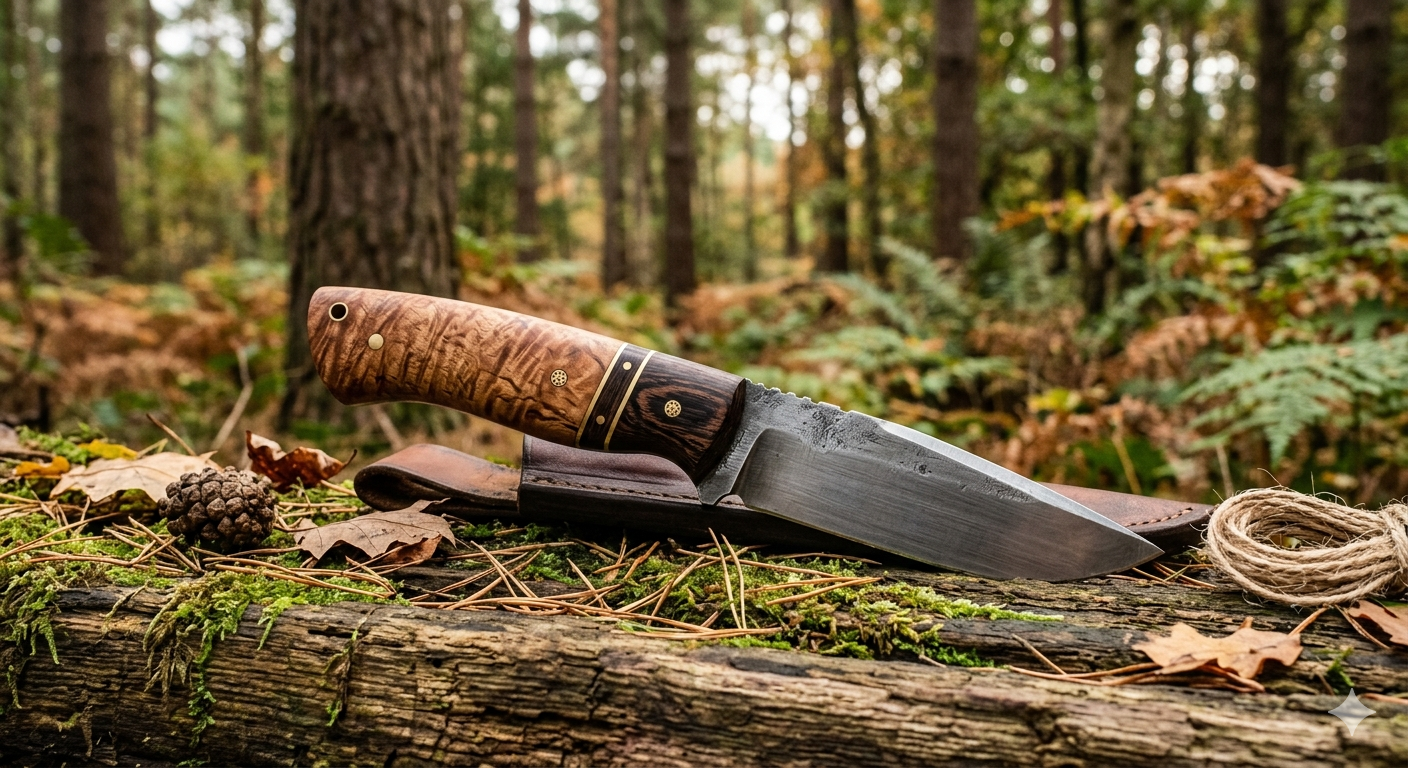

The handle of a knife is the part you actually use. The blade does the cutting, but the handle determines whether you can control it when your hands are wet, cold, or tired. Most people spend hours researching steel. The handle gets a glance.
That’s a mistake worth fixing.
Why Does Handle Material Matter More Than You Think?
Wood fails in the field for one main reason: moisture. Raw, untreated wood absorbs water. It swells, shifts, and eventually cracks. A handle that fits perfectly in a dry shop can feel loose after a week of rain and river crossings.
This is where stabilized wood changes the equation entirely.
Stabilization is a process where raw wood is placed in a vacuum chamber, then submerged in a liquid resin — typically acrylic-based. The vacuum pulls air out of the wood’s cellular structure. When pressure is restored, the resin is forced deep into every pore and fiber. The wood is then cured, usually in an oven at around 200°F (93°C), until the resin hardens inside the material itself.
Think of it like this: imagine a dry sponge soaking up water. Now imagine that water permanently hardens into glass inside the sponge. The sponge keeps its shape, its texture, its look — but it no longer absorbs anything. That’s stabilized wood. The grain, the figure, the color — all preserved. The weakness, gone.
The result is a material that resists moisture absorption to less than 2% by weight, compared to 12–20% for untreated hardwoods in humid conditions. Dimensional change drops to near zero. The handle stays the same size whether you’re in the Arizona desert or the Pacific Northwest in November.
Stabilized vs. Raw Exotic Wood: What Are You Actually Choosing Between?
Not all wood handles are stabilized. Some makers use raw exotic hardwoods — and for good reason. Here’s how they compare in real field conditions:
| Property | Stabilized Wood | Raw Exotic Hardwood |
| Moisture resistance | Excellent (resin-filled pores) | Varies by species (low to moderate) |
| Dimensional stability | Very high | Moderate to low |
| Weight | Slightly heavier (+5–10%) | Natural weight |
| Workability for makers | Easier to shape, less cracking | Requires more care |
| Visual depth | Enhanced by resin (vivid figure) | Natural appearance |
| Durability in field | High | Depends on species and finish |
| Cost | Higher | Lower to moderate |
Choosing stabilized wood for its moisture resistance means accepting a slight weight increase and a higher price. The trade-off is real. For a knife you carry on a two-week backcountry trip, that trade-off makes sense. For a display piece or a dry-climate EDC, raw exotic wood may be perfectly adequate.
Which Exotic Species Are Actually Used — and Why?
Makers don’t choose wood randomly. Each species has a specific combination of density, grain stability, and natural oils that makes it suitable — or not — for a working knife handle.
- Desert ironwood (Olneya tesota): One of the densest North American hardwoods at 65–75 lbs/ft³. Naturally resistant to moisture due to tight grain. Requires no stabilization in most cases. The trade-off is that it’s extremely hard to work — it dulls tools fast and demands patience.
- Stabilized maple burl: Maple burl has a wild, unpredictable figure that makes every handle unique. Raw, it’s too soft and porous for field use. Stabilized, it becomes one of the most durable and visually striking handle materials available.
- Cocobolo (Dalbergia retusa): A Central American rosewood with natural oils that repel water and provide grip even when wet. Density around 68 lbs/ft³. The downside: those same oils can cause allergic reactions in some people during shaping, and the species faces increasing trade restrictions under CITES Appendix II.
- Stabilized buckeye burl: Soft in raw form, but after stabilization it holds up well. Known for dramatic color patterns — greens, blues, purples — often enhanced by dyed resin during the stabilization process.
“When you’re evaluating a stabilized handle, press your thumbnail into an inconspicuous area. If it dents easily, the stabilization was incomplete — the resin didn’t penetrate fully. A properly stabilized blank should feel almost like dense plastic under pressure, while still looking and feeling like wood.”
Does the Wood Actually Affect How the Knife Performs?
Yes — in ways that go beyond grip comfort.
A heavier handle shifts the knife’s balance point toward the rear. This makes the knife feel more controlled during fine work — skinning, detail cuts. A lighter handle moves balance forward, toward the blade, which suits chopping and heavier tasks. Desert ironwood, at 70 lbs/ft³, adds meaningful weight. Stabilized maple burl, at around 35–40 lbs/ft³, keeps things lighter.
Here’s a real example of how this plays out. A guide in Montana switched from a synthetic-handled knife to one with a stabilized ironwood handle for elk season. The added rear weight reduced wrist fatigue during extended field dressing — a task that can take 45–90 minutes. He reported less hand cramping after three consecutive harvests. The material change didn’t just look different. It changed how the tool felt after an hour of hard use.
Surface texture matters too. Raw cocobolo develops a natural sheen from its oils that actually improves wet grip over time. Stabilized wood, depending on finish, can be left slightly rough for grip or polished smooth. Most field-oriented makers leave stabilized handles with a light satin finish — enough texture to hold, smooth enough to not abrade your palm on a long carry.
What About Sustainability — Should You Ask Where the Wood Came From?
- Ask the maker directly where they source their blanks.
- Look for species that aren’t CITES-listed or under regional harvest restrictions.
- Prefer makers who use salvaged, reclaimed, or burl wood — material that comes from already-fallen trees or natural growth anomalies, not primary harvest.
Cocobolo and other rosewoods (Dalbergia spp.) are now regulated under CITES Appendix II, meaning international trade requires documentation. Reputable makers will have that paperwork. If a maker can’t tell you where their cocobolo came from, that’s a problem.
Stabilized domestic species — maple, walnut, box elder — are generally the most sustainable choice. They’re abundant, often sourced from salvaged urban trees or mill offcuts, and the stabilization process itself uses no endangered materials.
“The stabilization resins used by most professional knife makers are acrylic-based and cure fully inert. There’s no ongoing off-gassing or environmental concern in the finished product. The environmental footprint question is really about the wood source, not the resin.”
The Field Test: How to Read a Handle Before You Buy
What to look for in person:
- Hold it with wet hands. Does it slip? Does the texture change?
- Check the fit between handle scales and the tang. No gaps. No movement.
- Look at the grain direction. End grain facing the palm wears faster than long grain.
- Ask about the finish. Oil finishes need periodic reapplication. Resin finishes don’t.
What Most Reviews Don’t Tell You
A few facts that rarely make it into mainstream knife content:
- Stabilization resin adds approximately 20–30% to the weight of a porous burl blank, but less than 5% to a dense hardwood like ironwood.
- The color enhancement in stabilized wood is permanent — UV-stable dyes are added to the resin before vacuum infusion, not applied to the surface.
- Some makers use a two-stage stabilization: a first pass with clear resin for structural integrity, a second with colored resin for aesthetics. This produces more consistent color depth.
- Cocobolo’s natural oils can actually interfere with some adhesives — makers who use it must select epoxies specifically formulated to bond oily woods.
- Desert ironwood is legally protected in Arizona under the Arizona Native Plant Law. Legitimate blanks come from trees that died naturally or were cleared for development — not harvested live.
The wood on your knife handle isn’t decoration. It’s a material decision with real consequences for how the tool performs, how long it lasts, and what it cost the natural world to produce. Knowing the difference between a stabilized maple burl and a raw cocobolo isn’t trivia. It’s how you evaluate what you’re actually holding.